 Jesse StilettoJesse Stiletto
‹ Back to Episodes
May 30, 2025
Episode #22Interview with Jesse Stilettö
May 30, 2025 ◷ 1:22:58
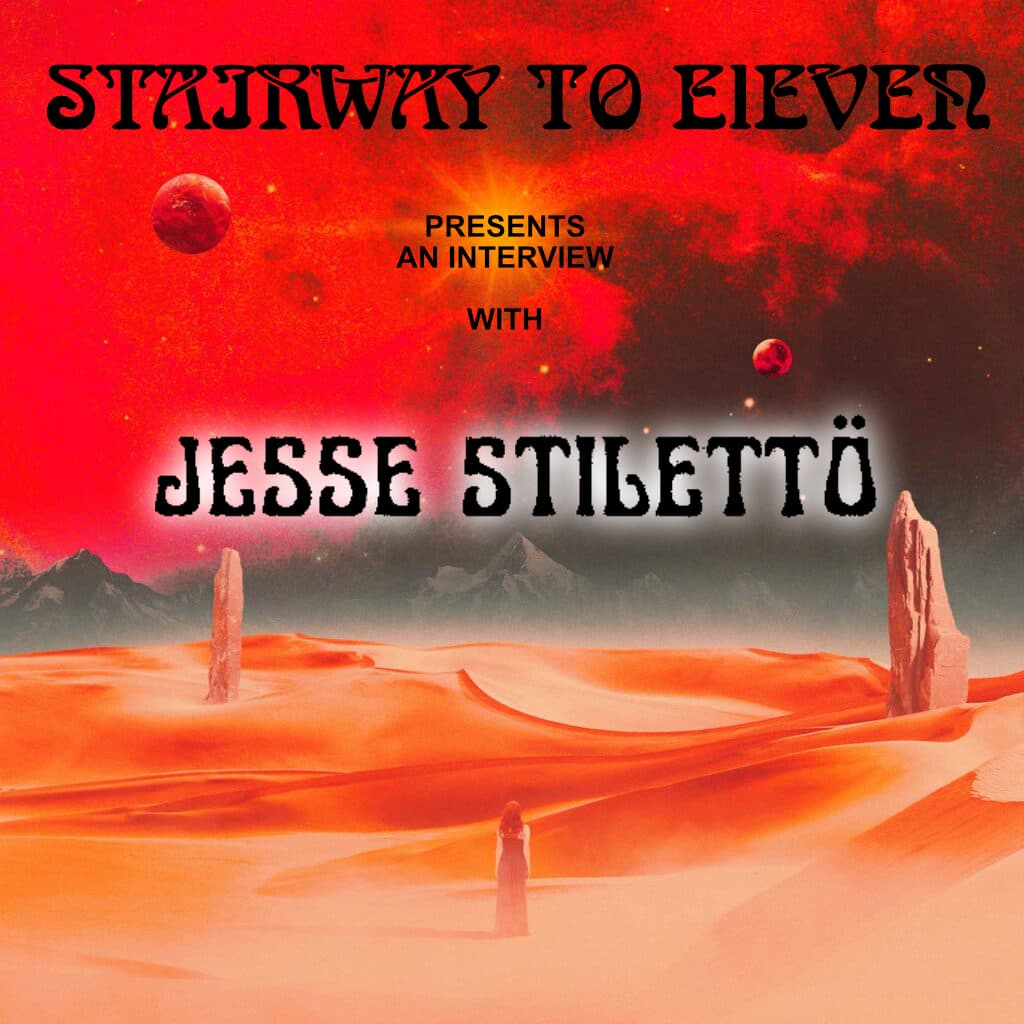
In this latest episode of Stairway to Eleven , George, John, and TR crank the amps and hit the dunes with special guests Zeta and Deneb from the scorching desert/stoner rock duo Jesse Stiletto . Fresh off the release of their fuzz-drenched, self-titled debut album, the bandmates talk about their creative process and the making of the album. Whether you're a seasoned desert dweller or just curious about this band lighting up the underground, this is one you won't want to miss.
22Albums Mentioned in This Episode
View Albums
Albums Mentioned in This Episode
View AlbumsOur AI is a real Trooper (Up the Irons!) but it still doesn't get everything right. So please excuse any missing or incorrect items.



 Led ZeppelinLed Zeppelin
Spotify Playlist
● Open SpotifyA bug in Safari prevents playing full songs, please use Chrome.
Transcript
View TranscriptDownload Transcript ⇩
Transcript
View TranscriptDownload Transcript ⇩ⓘ This transcript may contain errors. Please don’t quote it in your yearbook.
There's a podcast that's sure all that rocks hard is gold. And they're climbing the stairway to 11. When they get to there they know the record stores are all closed. But online they can get what they came for.
And they're streaming the Stairway to 11.
Hello and welcome to Stairway to 11. My name is George.
This is John.
N-I-T-R.
And today we are doing something absolutely brand new for Stairway to 11.
We have a band here to do an interview.
And not just any band, but a band that is steeped in mystery.
And they go by the name Jesse Stiletto. And they are known as Zeta and Deneb. Hello, gentlemen. Hey, good to be here. I was going to say they're nodding like enigmatically. On a podcast, we need to hear something. So who or what is Jesse Stiletto? Jesse Stiletto is a
In some ways, a human, in some ways, an interdimensional being, in a lot of ways, a way we might feel sometimes. But for our purposes and the way the human brain can kind of process it, it's a musical project that just weaves together a lot of influences that Zeta and myself have been wanting to kind of combine and just express over the past.
I don't know years and we're super excited to to unveil it this year that's awesome and we're glad to have you here yeah and I especially like the umlaut on the o the umlaut is um it's a tribute and um you know it's just one of those things you need to have a little bit of a little bit of extra mustard these days to stand out you know that's the little metal
Push Over the Cliff, right? Well, the question is, who's the tribute to? To Rock, man. Can't you tell? Listen to the album. No, I was just asking if it was more of a generic kind of tribute or a specific one. Oh, okay. Well, that's fair. Because I think we all know one band famous for an umlaut. You might know. You might know one or two, yeah. Yeah, Spinal Tap. Who put the umlaut on the N?
Unfortunately, a motley crew. Yeah. Yeah. The you guys are all aware, but the clue might be in one of the songs and I'm sure we'll we'll get there eventually. So I don't want to give away the price just yet. All right. All right. Well, I guess I'll take the second question. First of all, I want to say congrats on creating a solid hard rock album. That sounds like a mix of 70s hard rock, new wave of British heavy metal and desert.
"Bluoist" or "Cult" shows that bands of this nature are influences. What other bands served as influences for this album? And is there a band that people would be surprised to learn was an influence? Of course, you know, tons of bands, but maybe a couple that some people might be surprised about. And I'm curious if you guys know these bands too.
The Night Flight Orchestra. There's a band called Sog. Yeah, yeah. Our friend Jay, you may have heard of him, is a big fan of them. Sog, a band called Halas. Oh, yeah. It's H-A-L-L-A-S. I believe they have an umlaut as well. They do. Well, then they're obviously cool. Yeah.
Yeah, kind of, you know, those three. Christopher Mott, if you're familiar with him, he was the guitar player in Arch Enemy for a number of years. He has a couple solo records that Dineb and I really connected with when they came out. So they're kind of, you know, they're not Arch Enemy extreme, but they're just kind of really good, just hard rock. So kind of those, you know, there's,
There's a ton. We listen to a lot of stuff like you guys. Yeah, and perhaps some more obvious influences too, but some of those that Zeta just mentioned, as well as the Blue Oyster Cult cover, it's not always musical influences, but sometimes storytelling too. So we're trying to draw from sort of holistically from some of these bands. So it's sort of like weaves its way into the story that you're telling.
in a perhaps good way. I can't think of a word. I was trying to think of something. I was actually picturing in my mind a car driving on getting on to the interstate and driving through the desert. And but I couldn't think of a word that expressed that a single word. So, well, we hope some of it is fluid. But I will say a lot of it is almost none of it is linear.
We're trying to be
not just mysterious, but
in weaving together a lot of different things,
it makes
some of the comparisons and some of the
sort of ways you tie everything
together not always
apparent at first glance.
So we hope
there's just little threads that
the listeners are interested in unpicking
as they listen.
Go ahead, John.
I was going to say, you kind of touched on it briefly at the beginning, but given the album cover, the imagery, a couple of the song titles, actually a few, you know, as the portal opens, Feed the Moon, Dream of the Future, there's a, is there a running theme here? Is it kind of loosely based? Is it kind of like an, what do they call like shows analogies? I think that's what they call them. They kind of fall under an umbrella, but they're separate stories.
What's the background of this album? Yeah. It's definitely not a concept album where there's like one self-contained story. But there is a universe that we're trying to create and we're trying to play in with all the songs. Marvel 2.0? Well, maybe not Marvel, you know, cash grab, but we're trying to...
are connected and something important about Jesse is that as a character in that run that is present in some of the songs they're a time traveler so we sort of bounce around and it's purposefully not always intelligible but we sort of bounce around between different scenes of occurrences that might happen to this character that they might be involved in
And they kind of step in and out of that throughout their discography. So think of it more like that, you know, sort of a building on a broad narrative and contributing pieces to the puzzle along the way.
Yeah. And to follow up on that, how did you decide to cover Stairway to the Stars? And are there other songs that you considered? Zeta, why don't you take that one? Sure. There were other songs we considered, and we might still be considering them for future. That one was one, though, where we, you know, we had our options, and that one just seemed to fit really well and that we could create.
a different enough cover to, you know, with just the two of us make it, you know, just straightforward, hard rock, maybe a little bit of psychedelic-ness in there. And, you know, it, Blue Easter Cult has, you know, a lot of songs that are very kind of, what word am I looking for, just kind of, you know, all over the place in terms of parts length, whereas this one, just kind of straight up the
You know, rock and roll. Don't kill me. Don't hate me. But I have an idea for the next album, a cover for the next album. It involves time travel. Since you opened that door, I'm like, Jesse goes back to the 80s and meets a girl. And then you can cover Jesse's Girl by Rick Springfield.
Well, George, one mantra that Zeta and I have tried to live by in this project is there are no bad ideas. So this falls under that umbrella. There are no bad ideas. No bad options for cover song. Yeah, there are some ideas that you may not choose to do. Masterfully done. I am a silly man. George. Yes. I actually the Desert Stoner version of
Bessie's Grill would really be pretty cool, I think. Yeah, that would be very cool. I'm not hating on it at all. Yeah, I kind of, I actually wonder how that would go. Yeah, while the Blue Oyster Cult lends itself to the style already, the true mark of genius is to make the song fit from an 80s pop rock style into your style and make it work. I don't disagree at all, but I will.
I'll say one thing Zeta mentioned uh when he said it's a song that worked for us um he means like literally the the two of us can play it together and make it sound full you know it's it's just us two um and same in the recording situation which most of the tracks were recorded live um for most of the parts minus some overdubs um and not all songs that would be
possible for us. Yeah. I was going to say, I can't believe we said this. I haven't asked this already, but who does what? If there's only two of you, there's got to be some multitasking. A little bit. Yeah. I, Deneb, play guitar and vocals. Zeta's on the drums. We both contribute riffs and other parts. There's a little bit of, you know, studio, a couple of keyboard parts, things like that, and other percussion. But,
Mostly it was just guitar and drums rocking out. That's the way to do it. Yeah, when we're, and maybe we'll go into this a little bit more when we're writing the stuff, you know, it's, yeah, it's literally just drum kit and a couple of big amps and, you know, a pedal board with some, some fun pedals on there that we can get into. So, yeah. Yeah. Tell us about that recording process.
If you don't mind, I mean, how long did it take? Where'd you guys do it? Was it in, was it true garage band or did you guys actually go in the studio? Give us a little bit of history on putting it together. Sure. I can start this one. So we recorded it at our friend Chris, help me with his last name. Hoagie. Chris Hoagie. Like the sandwich. Like the sandwich.
You're making me hungry now. He has a studio at his house. And yeah, just in his basement. It took about, I think it was five days. Loaded in, you know, night before and then the next morning got up and we would do pretty much all day, you know. Yeah.
Yeah, just really tracking live as much as we could. There wasn't that much to it other than just taking the time. You know, it was a real studio experience. You know, it wasn't just this dude's basement. Like, he knows what he's doing. But one thing I will say, it was in the dead of March, which was, of course, a blue
in St. Paul where we recorded. And so that added a little bit of atmosphere to it, I have to say. Some desert rock stuff, but it was just like storming snow outside. Yeah. Definitely. Did you guys produce some demos going in or was it just kind of you practiced and then said, okay, we're going to lay it down? Did you kind of change things as you were there or was it all pretty locked in when you went into
the studio.
We definitely had demos.
Sorry, definitely had demos.
The wildcard was vocals just because I hadn't recorded vocals before.
So it's one thing to, you know, see what you can do on a little demo.
It's another thing when you're in the studio paying for the time and you can hear everything.
So luckily it worked out and we're very impressed and proud with what we were able to come up with but Chris helped us a ton with mixing and added a lot of great flavor to certain parts so certainly there were studio ideas things in the moment it's like oh yeah we gotta try this but for the most part we demoed it out and then just try to rip through it.
Yeah, can't echo enough how great Chris was with everything. You know, just the whole process. And, you know, even after the mixing, we sent it to be mastered by Dan at Sunroom Audio out in New York. And there was even, you know, there was even a little hiccup. And he worked with Chris kind of behind the scenes to get things kind of smoothed out. And yeah, they both did a,
Did a fantastic job. Yeah. Well, it's evident because I mean, it sounds great.
Thank you. Yeah. Speaking of that, I have to ask this because when it came through to us and I listened to it, I love that you guys did a little bit of it. And I don't know if it was intentional. Obviously, it was intentional, but I don't know if the intent was intentional, if that makes sense. The little fake out at the beginning where it does sound like a poor demo.
And I was like, really? And then it kicks in and I was like, you got me. I like it. I like what you did there. Was that something that you came up with in the studio or did you have that in mind to say, hey, let's start out this way. Let's let it feel like, okay, this is just some crappy demo. And then just blaze right in, which I love. Every time I hear it now, I'm thinking, I want more of this. Believe it or not. So. Yeah. Yeah, that was one.
I think I had the idea it was before going into the studio when we were demoing stuff I just I don't know we're talking about this recently I don't know what you know if I if I had heard it in a song somewhere a specific song or what but yeah I just kind of had the idea and I was like you know we should we should try this with this one it's the first song on the record just kind of really just explode you know.
It's sort of like being in the next room and hearing it
and then walking into the room. I'm like, it would be cool as if there was like a creaky door, like a
and then boom, it hits you, you know, like you just walked into the room.
And the song title's appropriate, obviously. As the portal opens, it's almost as if it's opening as you're listening, which I really dug, so well done.
Yeah, totally. I mean, that's the fun part of writing music. Speaking for myself, I guess.
Just tying little threads together, whether it's lyrics with the music or a little production decision with the theme of the song that listeners can make some of those connections. So really proud that you're putting that together. But also a songwriting approach, I think Zeta and I share is trying to find opportunities to include like just little interesting moments in songs. Yeah, it's about riffs and it's about like executing.
something, you know, powerful or catchy or whatever mood you want. But I think in a lot of songs that resonate with people, there's like moments in them. And it's not the whole song. It's like a specific thing that's like, oh, yeah, when that hits at the right time, it just helps the whole thing click, even if it's just like a two second part.
So I'm glad you brought that up because I wanted to bring this up about the song Feed the Moon.
Midway through that song at the 340 mark, there's some cool, what sounds like open string, somewhat dissonant stuff going on. And it really adds to the air of mystery that surrounds that song. And I just wanted to ask you, are you using an alternate tuning there or are you just employing like open string fingerings with standard tuning in that section there for Feed the Moon?
Yeah, well, well noticed. That section absolutely has open string fingering and chords kind of sliding up and down the neck. And it, you know, as it often is, there's like some pleasant dissonance that we decided to like kind of keep in there. We found it was pleasant or, you know, added to the song.
Right, yeah.
We were kind of talking about that. I was like, is that two guitars? Or did we put a third one in there? There's an acoustic guitar, an electric guitar. I can't remember if there's another one, to be perfectly honest with you. But yeah, open string chords, something we deploy a fair amount, honestly, because it kind of gives you that kind of mysterious sonic texture, allows kind of a big, broad sonic range.
A little bit, but if you let it ring out more. Yeah, exactly. I mean, it kind of, like to me, and so that's in standard tuning then. It's actually C-sharp standard. Okay. So you kind of drop it down or? Yeah. Yeah, it's a step and a half down from C-sharp. Wow, okay. Also known as Black Sabbath. Yeah, so it gives it a heaviness, but it gives it this real,
I think that open string fingerings and tuning, or the tuning is standard, but just the getting those dissonant sounds, I think, really kind of was just a really cool element to that. And you talk about moments in a song, and to me, that pretty much,
Like, the song was cool before that. And then that came in and I was like, whoa, that's really cool. And so I really enjoyed that. So I was really curious about that because I, you know, I kind of thought that that might be what was going on there. But I also was kind of thinking, well, maybe they did like some sort of alternate tuning that gave it that kind of sound. But anyway, that was just my, you know, curiosity about that.
I've never been able to understand how anybody even tunes to C sharp or God forbid the people to go lower. Maybe it's a seven string. I don't know. But I mean, obviously not Sabbath. But, you know, people are tuned to like B. I'm like, oh, it's just not occurring to me. Seven string. But, you know, I tune my guitar to C sharp and the strings are just flopping on there. And I'm like, how do you even play like this? You know, I've got like a detuner pedal that I could use, but that doesn't sound right. So. Thicker gauge strings, George.
Yeah.
Ah, thicker strings.
Yeah.
Need like 13s or something, right?
Yeah.
I use like 10s, so.
Hmm.
Yeah.
I have wimpy fingers.
Nothing wrong with that.
Yeah.
Um, I, because we have a time machine and we can do this, I could also edit it if
I so chose, uh, but I want to loop back to the beginning because we didn't ask anything
about the history of the band and where you came from, I don't think, really.
Like, you know, how, how did the project come together initially? And, you know, what was, what made you guys want to do this? Zed, why don't you start now and I'll add on. Well, um, yeah, I don't know. It was, um, I guess, you know, just over, like we said, a brief,
I guess many years of you know growing up together listening to kind of just all the classic rock and getting into the little bit heavier stuff that we could and we kind of went you know a certain way for a while with some things and we always kind of just had it I think in the back of our mind that you know someday we want to
We want to explore a little bit different avenue. And yeah, it just kind of worked out that we, I don't know, just kind of started tossing random ideas back and forth saying, hey, what if we started this thing? What if we, you know, and just kind of, I guess we just kind of went for it in the end. And to be fair, it started off very different.
I was listening to some of the very early demos recently, and the songs were very different before even we kind of found our identity, as usually is the case with the band, you know, choosing the name and thinking about that. Yeah, go ahead. Yeah, we, Zeta and I have past lives in some other musical endeavors.
As you said, it's just been an ambition to see what we could do as a two-piece at some point. We'd been kicking around the idea for years. It took years to get from some demos we liked to a place where we could record them. But yeah, the real identity in the story formed pretty late. Some of those demos he was referencing are much more like blues rock.
Some of them are like pretty much yacht rock, like very different stuff. And it took us a while to like find the gravity to really solidly orbit around what we're doing here is this kind of like hard rock, desert rock, proto metal, you know, a little bit psych kind of thing. And one thing that honestly really helped a lot solidify that vision,
was deciding on the name.
When we were like, oh, Jesse Stiletto, that's the name.
Okay, what does this mean for what the music needs to be to pay this off?
And we were kind of interested in having a story.
So what do we need to do to put some meat on the bones of this?
And it kind of went from there.
So that's pretty impressive because, you know,
I think like given what you just said and how so it sounds as though both of you kind of continued to work to get this to where you wanted it to be in a collaborative way and and that's pretty cool because you know very few musical acts will actually
a backstory, a theme,
an understanding of what the meaning of the band is.
It helps that there's only two of you.
So it's easier to have like minds when there's only two of them
rather than three or four or five.
And it becomes really difficult
to have enough of a common ground
or a common understanding of what it really is. And so
when you can solidify that with two people, you can come to that conclusion a lot faster
than if you've got to kind of work on other people to say, well, this is what we think it should be.
or, you know, come to some sort of consensus with a larger number of people.
So you want to do my song.
Yeah.
And so, you know, but it's interesting, like the idea that like there was some like a yacht rock element to this or that there was like this easy listening, chilled out 70s thing maybe.
But I really appreciate the fact that you guys, you did the backstory, you did the work, you really crystallized what you wanted this to be, and then you did it. And I really can't wait to hear what's next, because we've got plenty more questions, but I don't want to wrap it up.
I want to jump to the end of the questions.
Yeah, I don't want to end.
I'm not saying that.
But I just want to say, I think it's really cool that you've developed this.
And the album artwork kind of links into that.
The songs, the mystery, the style, everything kind of all kind of goes to that.
So I think that's really good.
And I think the fact that there's only two of you really kind of helps a lot in that regard.
because if you both are firm in that together, then, you know, and you're united, it makes it, you know, it makes it a lot more solid than if you've got other people that are kind of on the fence or not sure about the concept or I don't know if I, you know, really get into this or whatever it is, you know, and I'm sure you guys have been in other bands where there have been other people where you like working with them, but like,
Maybe they're not totally on board or whatever it is. It's great that you guys are united and you've really kind of hashed this out together. Actually, I think they both hate each other. They're done, right? You guys are breaking up, right? Yeah, this is just witness protection so we don't hunt each other. No. Well, I mean, first of all, thank you. It's really great to hear that you feel that way because it's a lot of fun.
of creative energy, right? And like when people appreciate it in a way that's even close to how you're appreciating it as an artist or like even appreciating in different ways, you never anticipated. It's just like the coolest thing. That being said, we still have, you know, between Zeta and I, there's still consensus that needs to be built. And it's not like we never disagree about things. So, you know, we hash out what we need to hash out. No means no. Well, you know,
I would say collaborative is the key word. That's really the special sauce, at least for us. Try and make all those decisions together. I think as I mentioned before, we're both contributing riffs and songs and we both had riffs and songs cut when we chose our direction. It's like any other kind of relationship. It's give and take. But once you can kind of figure out what you need to be cohesive about,
in terms of the story and having everything linked together, then that's kind of a filter. We can blow our ideas through and it's like, okay, does that further what we're trying to do or not? And yeah, it's cool to kind of build a universe like that.
So jumping ahead in the timeline, just to keep everybody guessing, because I'm making this shit up as I go.
Based on TR's talk about how much you put into this ahead of time, now that it's marinated a little while, are you like, yeah, let's do more of this? Or have you already moved beyond this into something else and album two is already thought out or at least there's a direction you know you're going in? And I'm not asking you to tell me what that direction is if it is a new direction.
I'm just curious to your mindset on moving forward. Sure. Oh, go ahead. Well, I was just going to say there have been demos sent already for some new ideas. We've bounced around different, I guess, I don't know if they would be lyrical concepts yet or concepts even, but there's
There's things in the works, for sure. That being said, this album is still only a couple months old, which it's crazy to think that because we recorded it in March of 2024. So it's been a long time coming a little bit. Yeah, I'm curious because one album, Eddie's a mummy. The next album, Eddie's like this space traveler guy. What the hell, Iron Maiden?
You know? So anything can happen.
Yeah. Just on that, I think one thing we have decided on, and I don't think it's spoiling anything to say this, is that, like, the story is going to drive a lot. And what's cool about the story that we're trying to build is that it can, we don't have one narrative.
We're trying to contribute pieces to a puzzle that eventually will fill out the universe over time. So we're not necessarily beholden to what we've done before. Let's put it that way. We're totally open to a surprising song, you know, or two or three or whatever on whatever happens next.
I'm sure they're you know we're also going to try to build the bridge from this album to the next one in a way that's satisfying but also you know do the next thing in a way that's satisfying too for for ourselves and for people who care about it cool all right staying in the present then we won't go to the future yet but how's the reception been so far have you guys gotten a lot of
I guess webzine or site traction, you know, reviews. How has everything gone with that? Zeta, expand on this when I'm done, but surprisingly well, I think it's gone. You know, from starting from absolute zero, it's not like we did no promo, but, you know, we're DIY here. So it's been great.
communities we've sort of tried to push the music into have been super receptive gotten some great feedback gotten some great like quandaries about like who are these people and what are they doing like that's been super fun to try to see some people trying to decipher it in a way we kind of hope they might but yeah yeah go ahead Zeta yeah like Daneb said surprisingly well
these different scenes and genres of webzines and groups of people out there in the world. We really didn't have too much of an in as the things we were involved in or are involved in otherwise don't really touch on in these groups. Surprisingly well.
We had, Deneb mentioned kind of a quandary, we had a podcast recently that was wondering if the album art or if the music even was AI. So that was kind of interesting, first time that's ever happened. And so we reached out and we didn't reveal too much aside from, you know, letting them know that there's real people.
Yeah, humans made that. Yeah. Nowadays, it's getting a lot harder to tell. I mean, I've been playing around with AI music because a friend of mine sent me a song and I was like, oh, that's really cool. Who is that? And they were like, it's AI. And I was like, I was like, I could not even tell. And so I started playing around with Suno, which is one of the AI things. And I'm like, humans are irrelevant.
I can't do whatever I want. Humans would not make that part in Midway
through the Feed the Moon. I can guarantee
you that. Or I can say, hey, I
would not come up with that. That is too cool for
that. No. The real
stuff is still better, but it is
scary how difficult it
is getting to tell.
Sure. So
continuing to stay in the present
and on this album,
I just want to say the Devil's Lunch
rocks. I like how
it starts all kind of desert stonery
and then kind of gets into this rocking thing. So what I want to ask you is what would the devil's dinner sound like? And whose lunch do you plan to eat next? Well, I think we plan to eat John's lunch next. You better be careful with that. I guess it depends what he's bringing for lunch, I suppose. But what would the devil's dinner sound like?
Devil's Lunch, that was a Zeta riff that we expanded upon. And I think that was one we pretty much just like had that riff and we're like, okay, let's jam on it for like five minutes. And out of that jam, there were like four or five different parts. And we were like, okay, let's put this here and this here. Like, we got a song. Let's see what we can do with that. Devil's Dinner, I imagine, would be more ominous. Like, I don't know, some candles.
on a table and maybe you know it's like another course or two maybe an extra yeah you know it starts off you know a little bit romantic but then something goes wrong and you find out at the end like you've eaten a human eyeball or something i don't know you know where's the dog the whole time i'm thinking a main brewing company with their beers called lunch and dinner i was thinking that too
Yeah, the Devil's Lunch, that was, if I'm remembering correctly, that was one of the first ones that we had kind of hashed out together. And yeah, kind of like Deneb said, just we love the riffs. We love the riffs. That's what we build them around.
Well, I think it's time for me to ask a couple questions then. So, especially since you've mentioned that this was a lot of like, you know, recorded live in the studio kind of stuff, I want to know about the guitar tones used on the album and what you used to get them. I'm guessing there were both amps and pedals involved in this. Amps, pedals, guitars with strings. As opposed to a DI thing, you know what I'm saying.
I'm just messing with you.
Yeah, so the core sound was, we used two different guitars.
One's an Ibanez guitar from, I don't know, early 2000s or something.
Can't remember what it's called, to be honest.
One was a Bender Stratocaster.
Pretty much throughout the whole album, one of those is in one ear and the other one's in the other ear.
The sound was a mostly a Marshall amp with a JHS Morning Glory and an Earthquaker device's ZOR, which is, I think, a little bit of a newer pedal. Those Morning Glories just overdrive. The ZOR is like buzz distortion kind of thing. Some of the... So that's the core sound. Some of the little double lead things,
you hear are from a harmonizer pedal. So like a lot of those were played live. Sounds like more than one guitar really but it you know it isn't. I love those things. It's clicking on that pedal. And so you know dialing that in for the right key and the right interval and all that for the song because they're all different. And then a few other bells and whistles to kind of fill it out you know here and there you might hear a phase
or delay, things like that. But to be honest, it could have been a lot more complicated than it was. It sounds like more complicated. Well, but I think that the fact that it wasn't actually benefits the sound. I think it sounds really good.
the more you put in there, sometimes the more it can kind of detract from the purity of it. And so the fact that you guys got that with a handful of pedals, and when you're only talking about two dudes, that's pretty impressive, I'd say. Indeed. Yeah, thank you. We were just talking about this, so I'll mention it, but even just the choice to switch guitars, record more,
More than one kind of guitar went a really long way and just kind of a more interesting texture for like that kind of backbone of the music. So it isn't, at least in my humble opinion, it's not just about finding like the magic pedal or the magic amp setting. It's just like switching up some things that seem obvious, you know, like maybe you play on a different pickup. It just, yeah. More than one sound going in. I have. Sure.
It's stupid, but I have like so many guitars and I have like a guitar for this sound and a guitar for that sound and a guitar for that sound, you know, I'm like, well, this is going to be the ES-355. This is going to be the Les Paul. This is going to be the Strat. This is going to
at least, you know, Zeta and I, we try to lean into experimentation, not doing anything like super crazy. But as I said, a Stratocaster was one of the guitars, not typically used in heavy music. I know Iron Maiden, whatever, you know, people use Strat. But between the two of us, we have Les Pauls, we have an Ibanez Destroyer with three unbuckers, you know, like we have these heavy guitars. So it's like, well, what if we,
What if we tried to build something sick and satisfying without that? What would that mean for it? Just trying to take the slightly longer path might yield something just a little bit different and unexpected. So sometimes we lean into that stuff too. Yeah. So this may not be up your alley, but there's a band called Emperor. Heard of them. And John and I just went to see them. And Eson, the main guy in that band, played a freaking telly.
which blew my mind. I was like, what? I mean, it looked like some sort of custom job. I mean, I think it had humbuckers in there instead of single coils, but it looked like a Tele. George Led Zeppelin won, right? That was mostly on the Telecaster. That's blues. That is Tele. That's where Tele belongs. Yes, but Emperor. Black metal. On a Tele? Sorry.
I'm dabbling in things I don't understand. Exactly. Stick in your lane, buddy. All right. Stay over here. I have an answer for you on that, George. Yeah. It's Eson. He can do whatever he wants. Well, absolutely. Absolutely. And he did. I was like. And he did. I was like, man, maybe a telly is really good for that tremolo picking because it's got that tone, you know, but I don't know. Anyway. So my next question. Riffs, generally speaking, where do they come from?
and why do so many of them congregate around you? Well, I guess I'll start this one. Like I said, we love riffs. I think Deneb and I both have, just in our musical tastes, have evolved over the years like, you know, everyone's tend to do. And we've just found that, you know, even though there's plenty of guys out there who are amazing, amazing players, way better than we are.
and they can fly up and down. They know all the scales and the modes and everything. And that's awesome. I wish I could do that. But we're just drawn to, you know, maybe there's a riff that is three notes, three simple notes. And that's what we love, you know, just resonates with us, makes us feel a certain way. And I don't know, I think just really fits with what we're trying to do with this project.
Yeah, I think definitely listening to just like a ton of music helps riffs congregate around you. In different kinds, music mean different kinds of riffs. So if you're listening to all different things, like using all those influences means you have an easier time coming up with something interesting usually. But yeah, I don't know. Just trying to find the thing that like kind of creeps into your bones.
You know, I'm,
when I'm playing on guitar,
sometimes I'm playing a riff over and over.
I know it's good when my partner will like be humming that riff later on during the day.
I'm like, okay,
it's a thing that wormed its way into someone else's consciousness unintentionally.
So like, there's probably something there.
That's the kind of thing that I think,
you know,
where you can't help but kind of nod your head.
Yeah.
And I will mention too, that was the case with Devil's Lunch when we were writing that. Both of our partners, you know, we would rehearse it, go, you know, somewhere with them. They were, you know, in the house when we were playing it and they would be humming it and it was like, all right, I think we got something.
Yeah. If you can get something that's sticking in somebody's head, you need to run with that.
Yeah.
So I realize this isn't perhaps what traditionalists would call metal, but it does rock hard and heavy at times. So would you remotely classify this as metal or strictly rock, hard rock? And I'm asking for a friend to make it a mid-year list.
Well, I think that's a totally fair question. But it makes me want to also ask, you know, rhetorically here, like what is, what does make something metal? You know, what actually connects Iron Maiden to cattle decapitation, to emperor, to, I don't know, yeah, hate breed or whatever.
I don't know.
Like all those,
there are definitely connection points for sure.
but I think it's less about like what the music actually is and more about like what the energy and mindset is.
Attitude.
Yeah.
So I use that a lot.
I mean,
my friend uses that a lot.
And he,
he,
he put your album as the album of the month when it came out and he took a lot of crap for that.
And so he's,
uh,
He's curious about whether that would fit on his mid-year list or not. So I just thought I'd go straight to the source and see if I could help him out. Well, I don't think we can be responsible for any outcomes of being bullied or not bullied by friends this person might have. But I would say if it puts you in the mindset, gives you energy, and makes you feel a little bit like you're kind of putting some of your armor on.
against the world and you can do a little bit more than you could before you started listening to the song i think that has a little metal in it i agree yeah george do you feel like you want to wear your loincloth when you listen to it i feel like i don't want to wear anything at all that's pretty metal i just want to jump around naked bang my sword yeah which i'm the only one here that doesn't have any hair that sucks i'll look at all these lovely locks
Jeez. Yeah. TR's growing his hair out now too. Anyway, thank you for that. I'll let my friend know. Yeah. I hope they're doing well. Hey, I want to circle back to something that we sort of touched on, but I want to get to it. I want to ask about the artwork. Now, I am not going to pronounce the artist's name. I want to let you guys do it in case you know it.
because I don't trust the W there. I don't know if it's a V or a W. There's two Ws. Right. No. Pronunciation though. No, I know. So I want to ask you guys, how did you come across this artist and how did the design of the album cover come about? Was it with you guys, them, the person? Give us a little bit of history about this. And can you pronounce it? Yeah. We know him as Mirko. Okay. I don't want to mispronounce.
He's a fantastic artist from Berlin. He works with a lot of even bigger bands. Bands like Witchcraft, Zach Sabbath, Billy Cobham. He does a lot with Heavy Psych Sounds, that label. It was one of those things where we were just looking around Instagram and the internet for art.
that was inspiring. And we stumbled upon his page and we contacted him. And he's super nice, very professional. And even though he works with some of these massive bands, gave us the time of day and we worked with him. And he has some similar pieces that look kind of in that same style as our albums.
with kind of the landscape.
And, you know, we gave him that and kind of said, you know, see what you can do.
And he literally sent it to us, sent something back and we had one edit and that was it.
Oh, that's awesome.
And he knocked it out of the park.
But yeah, I can't recommend him enough.
I mean, he seems to be pretty well known in the Doom Stoner scene.
But yeah, he's a fantastic guy. Yeah, I checked out his Instagram page and there's a lot of great stuff on there. I want to say that I actually like that kind of scene. I'm trying to think of the right word I want to use, but it's almost like a storytelling scene. You know the old science fiction? I have a friend who does another podcast. He always talks about science fiction covers from the 70s, which I'm a big fan of.
I love it. I love the story you can gleam off of one image that you can create your own storyline from that one image, which is also for those of us who are older, we did with our album covers. We were kids. We ran with that. And also when you got into the 80s scene for metal, when you flipped it over and you saw everyone in their leather and studs and you're like, wow, these guys are so cool, not knowing anything about them. But your album cover does that.
You kind of can create your own world. You know, you have your world because of what you're building. But when you're looking at it, you can kind of just go off into a space and kind of add to it, you know, like we all did when we were younger. You can kind of create this, your own universe with the album cover. I kind of dig that. So this, how did this concept come about? I mean, we, is this something that just you wanted to do or did it kind of develop over time?
Yeah. First of all, that's like, we really dig that sort of like 70s sci-fi art as well. And we were kind of looking for something like halfway in between that and like fantasy, you know, not like goblins and wizards necessarily, but just felt a little bit fanciful, like a slightly different world you're stepping into. I think we like the idea of a landscape,
particularly kind of for what you're talking about john like um a viewer has to bring something to that you know there's a lot of space it feels like you're stepping into something and uh we think about music that way too like the listener brings something to the song when they listen to it um and i think that's something to be embraced not to fight against so um and just like one little nugget that's kind of funny lending itself towards that little bit
of extra space that the user can bring something to the user the listener can bring
something to um the one edit we had of the image was turning the figure around because they were
originally facing the viewer and we were like that's just too much we want imagination to kind of
take over for what that what that person you don't know what it looks like yeah yeah you gotta
You gotta fill in the blanks. And that's pretty cool. That's good. Well, then it almost kind of makes it like you're looking through their eyes a little bit to what they're staring at. And it's not that it's being directed at you. You're kind of a third party now as opposed to being directly connected to the person looking at you. Yeah. I'm looking at it now and I can't even... It would just be weird if they were looking forward. They'd just be like, hey, why are you...
I hear you standing in the middle of this desert, like out there by yourself, just staring at me. But, but to be taking it all in makes much more sense. So you're like, is there something I should be seeing here that I'm not? What's going on here? Yeah. I think it's always good to make people ask questions, you know, Zeta and I definitely don't have the answer to all the questions, but if you're making people ask things, I think you're doing something right. Right. And I, I think,
You know, in a lot of ways, when you look at something like that, you don't, you're not really thinking of specific questions in terms of like, oh, I want to know this or it just, it's just part of the whole thing. When you look at it, you're like, oh, okay, I don't know who this person is in the middle of this picture, but they're looking out. Okay, what's going on here? And you kind of start to,
You have questions, but you start to answer them yourself, right? You're not really relying on anybody to answer those questions for you. And I think that that, like, the fact that you have to generate the question first and then come up with the answer is the whole key to it. Because then you're interpreting it yourself. There's no, there's really, and that's really, I think,
What is so gripping about this in terms of like, you've provided a context or a canvas for people to come up with their own questions, come up with their own answers based on what the music is telling them, what they get out of it, and how they see it. That, you know, like you said, sometimes you don't have the answers.
You don't even have the questions. You didn't even intend for that. Maybe you just created this thing and they've gone off and run with that. Like John said, when we would look at some of these album covers, we'd come up with whatever our imagination would develop from that. I think that level of creation and that level of allowing
people to generate this stuff for themselves is what endears these kinds of records and bands to people. Because it does allow them, it doesn't just provide all the information and then that's it, right? They have to come up with it. They have to, you know, there's a mysterious element to a lot of these songs. Musically, it's mysterious.
And then visually and optically it's kind of mysterious.
But yet it all kind of weaves together.
And I think that that's something that people can appreciate.
And when you don't just hand it to them, it assumes a little bit of intelligence and a little bit of creativity, which I think is really key nowadays.
because a lot of things just kind of get handed over because people don't want to take the time to look at something and think about it themselves. And so I appreciate that from you guys. You know, on the flip side of that intelligence coin, TR, you want to make people work too dang hard. I'm all about, I just want to listen to it and like it. Well, you know, there's that element too.
I take extra time to sit down and absorb it.
Of course, I am teasing.
Okay. Sorry. I tend to go off on this rant.
I know, I know.
You're an easy target.
I was drinking a triple IPA and George is drinking a Miller Lite.
This is a super stout here.
17.3%.
Speaking of time machines.
Ooh, there you go.
Is that D.D.?
Is that D.D.?
Idiom. Throwback.
Who's the brewer? Idiom, down here in Frederick. Oh. For those of you that are just listening to this and can't see, George held up a beer in his... I can't really see what that was there, George. It was Idiom Brewing Company's Throwback, and it's Back to the Future themed. The throwback is in that Back to the Future font. Back to the Future font. There's a Hop character.
who is wearing a vest and hopping into a DeLorean. He's all like, he's like, I don't know. Yep. Brewing in California uses that. So I thought your beer is going to be called 1.2 gigawatts. You know, I think I've seen something like that too. Maybe. There's so many cool things. We got derailed. Yeah. Sorry. This is the other podcast thing. Let's get back to Jesse. That was no derailing. That was just stopping at the station.
I gotta get one for this weekend because I saw it last time I was there and it's it's something about ninja cats and I'm like that's totally a metalheads thing so is it a Devin Townsend beer I don't know yeah sultoid I actually do want it so I'm totally interjecting because I'm not drinking a beer if I were I would share it but I do want to respond to TR's uh philosophizing which I'm totally here for sorry to interrupt um no no no no
No, beer is one of the great gifts that we have to enjoy. So Zeta and I had a conversation when we had conversations when we were writing this stuff. Like, is the story too obtuse? Are the lyrics too obtuse? Like, are the connections too tenuous and thin? Like, is it worth saying that this is all in one universe if people can't connect those dots easily? Or if we're not telling them what the connections are?
are. Like, should we spell it out more? And we basically decided no. Like, it's worth the effort if somebody wants to put into it. Somebody has to peel that onion and let them do it themselves, right? Like, let them kind of make those connections. And if they're wrong, it doesn't matter. Totally. Totally doesn't matter. And I think a big inspiration we've talked about already, but Blue Oyster Cult or this music
but also us personally growing up listening to music and hearing those songs that like didn't really make sense but painted a picture and trying to figure out what they were talking about and what the connections were um and again it didn't matter if you were right or wrong but like it built a sort of unique narrative within each of us right um and we were like if we could just do something like that that'd be pretty neat
And you're right, it's resistant to sort of the, I don't know, 30 second clip on Instagram or TikTok culture, right? It requires some other commitment from the listener. But in doing so, you hit the nail on the head, like it assumes intelligence of them. We definitely see it as we're trying to respect the people who are interested in that sort of thing in a world in which it's a great way to do it.
It's harder to find that.
Well, yeah.
And I think there's an element of discovery that is associated with that, right?
Because, you know, you're going to make your own interpretation of what this means.
And it may or may not be right, but you can feel as though this is your discovery.
This is something you thought about.
You looked at.
You spent time kind of picking it apart.
And I mean, I did this, you know, in my childhood bedroom, listening to albums and trying to think about like what I thought this meant. And it may have nothing to do with what it really meant to whoever wrote it or, you know, what was played or whatever. But, but there's an ownership that takes place when you spend that mental energy. And I believe that, that,
Taking that journey is what draws people into it and gives them that appreciation and love for what the band is doing. Whether they got it right or not, they are making their own discoveries, they're making their own assumptions and coming to their own conclusions about what it may or may not be about. And whether it's right or not doesn't matter because
They've already invested themselves in what it means to them and how it makes them feel and what they get out of it. And so I applaud you for making the conscious decision to let people come to their own conclusions and for letting people exercise their brains enough to take ownership of your music and what you've put in front of them as
as an artistic product.
And so I appreciate that.
I agree with everything you just said, TR.
I just want to be clear on that before I continue.
I think it's a beautiful thing.
And it's something that I do all the time with music.
I hear a song and I tweak the narrative to what I'm feeling or what I need out of the song.
And it may have nothing to do with what the songwriter actually thought.
But how many times have you seen interviews, particularly maybe bands from the 70s, where you're like, dude, so what was this song about? And he's like, I don't know, man, I was tripping balls. I just woke up. I had some lyrics, you know, and you're like, oh, I mean, yeah, and I gotta defeat a baby, you know. So I think it's safe to assume. White Snake did not influence this album when it comes to the lyrics.
I don't think consciously but
hard to know for sure
I'll be honest I've always
appreciated slightly vague
lyrics because then
it gives it there's no
right or wrong answer then even if there was
intent from the writer of the
lyrics I like slightly vague stuff
because then you can kind of
navigate your own path and it
actually gives you a different
connection to the band than somebody else
but you still have a connection like somebody else it's just it's from a different
perspective and I always always appreciated that I mean I artists want to write specific things
they're entitled to it's their music yeah I just always gravitated more towards just slightly vague so
you think I think I know what they're talking about but you know what I kind of like where my place goes
and I think that it's very artistic um you know as someone who puts a lot of pen to paper uh it's
It's difficult to get your point across and still be vague about it. I mean, yes, you could just trip balls and write nonsense, but to actually have a point and make it somewhat veiled and a mystery, that takes work because I know pretty much everything I write is extremely to the point and no mystery whatsoever. And I'm like, this sucks.
Yeah, I mean, I'm not saying you're writing John Anderson lyrics from Yes, which absolutely mean nothing. They really don't mean anything. They mean nothing. I mean, it's cool to kind of think about what that might mean. But the reality is, he really didn't mean anything. That doesn't mean a damn thing. Yeah, there's a line of artful abstraction that is hard to walk, I have to say. And like, you know, metaphors can totally be overused and overblown. So you need a little bit of
of hand-holding for the listener sometimes. Of course. It guides your theme or your story or whatever it is you're trying to get across. Of course. Yeah. But I will say it wasn't like... We also did just kind of write what we felt shot from the hip a little bit. And after the fact, we're like, okay, does this feel coherent enough? And we're like, yeah, I think so. So all that is to say, there's a little bit of the...
Finding out what this means to us while it's happening, while we're writing it, you know? So hopefully the listener is like, it might feel a little participatory in that way, I guess. Yeah. All right. So I know there's only two of you. Is there any chance that you want to take this live at some point? Sure, I can take this one.
So we're not currently, at least in the immediate future, looking to play live, but, you know, we're definitely not counting it out in the future. All these songs we wrote, you know, with the two of us, with the intention of being able to play and write in, I guess, this project, you know, to be able to do it with two people and have it sound big enough.
So, um, nothing, nothing currently in the works, you know, if the, if the perfect show comes along and, uh, you know, we're not counting it out, but we're not actively, we're not actively looking, I guess we'll say that right now.
Just, if you did play it live and you're, you had this anonymity going on, you know, should we expect to see you and, you know, makeup or like a lot of these metal bands now they're all wearing masks with, you know, hoods and everything, you know, or are you just going to
RELY I rely on plenty of fog machines to consider your identities
well
and to not be cut in
too but yeah you know
when it does happen
we won't be doing you know masks or anything
like that but you know
kind of the usual
rock and roll kind of you know
maybe some sunglasses maybe
maybe a hat to kind of cover
you know cover our eyes a little bit
and that kind of
you know lends itself to the mystery of
When it does happen, you come to a show, you get a little bit more than other people might. You deserve to know a little bit more about the band. Very cheap sunglasses can go pretty far. You can do a lot with lighting, too. I mean, Sisters of Mercy comes to mind, but other bands like Panopticon and recently Emperor, and even what was the band that opened for Devin?
Tesseract. There's a lot of lighting. All the lighting's floor level. And so you can see there's a lot of silhouettes, but not a lot of facial features. It's both annoying and kind of cool. Right. Yeah. You know, I imagine there'd be plenty of fog and a little bit of a stage show kind of thing. But feel free to jump into that. We were even talking about ZZ Top as a band that they don't.
They are who they are. But can you imagine ZZ Top outside of like their stage personas and get ups? Like they kind of that's who you think of them as like, right, you know, if you saw, I don't know, you're not going to see ZZ Top at like Walmart. Right, right. So they can't imagine them in any other context. Actually, you would be about 40 people that look like that. Well, I actually met
Billy and Dusty. You did? I did. Granted, it was at a show, but it was an outdoor festival thing. But yeah, it was at the Preakness in Baltimore. And my friend's band was playing, and their trailer was next to ZZ Top's trailer. So when we came out, we met them. Oh, cool. That's cool. Yeah. Yeah. But yeah, like Deneb said, ZZ Top, that kind of thing.
We're not throwing on hoods or anything like that. Good. Because I'm done with it. It's a lot of that these days. Oh, every band. Enough. Yeah, definitely. I was going to ask, were any plants harmed in the making of this album? This music is so hot, I'd be afraid they might combust. If you are referring to my inability to keep a houseplant alive.
Yes, that's exactly what I'm talking about. If you are referring to a plant that may have been burned for a hallucinogenic effect, the answer is maybe. Perhaps. I don't know what else you'd be referring to with that question. Well, you know, sometimes things just start on fire. It turns out George has a little air of mystery of his own, I think.
It's up for interpretation. That is it. You're right. That is totally up for interpretation. Wow. Look at that. I'm proud of myself. George, you can do it too. I don't think we lit anything on fire. Truly. But we, you know. We sizzled the airwaves. We definitely went through an amp tube or two, I think. Oh, wow.
I was totally expecting like some orange amps based on how it sounds you know but a
Marshall I'm a Marshall man so I'm done with that um did we use the orange cab Zach I don't maybe just rehearsals or demos yeah but you're right orange is like the you know stoner doom thing yeah and it's you know it's funny um because we have you know between the two of us we have uh
Fair, you know, fairly decent arsenal of stuff. And we had a, you know, we were like, well, we could use this one. Well, that one should probably get serviced. Well, what about this one? Well, I don't know if that'll hold up. So, you know, this was just, I don't want to say it was the default, but, you know, it's Marshall's just, you know, tried and true. Yeah. Yeah. Lots of interesting vintage gear.
that breaks right when you need it not to break. That's the unfortunate thing about stuff of that age, because it's like, oh, man, it sounds good, but oh, man, when it drops out, you're really in trouble. Was there gear in the studio that you got to play with? I know a lot of studios, they just have stuff on hand, and it's like, oh, John played this piano, and so on and so forth. But I mean,
You know, there's usually some gear sitting around that's for use. And was that the case? Or did you bring everything?
We, uh, I was just going to say there, there were, you know, amps and things there, um, that, you know, maybe we could have used, but it was all the stuff that we brought aside from, um, some of the, the synthesizer parts. Um, I think there's a couple, two, three, maybe on the album. Um, those were there. And then, um, Chris had, um, you know,
some percussion that he let us use and a pedal or two that were just kind of just to kind of add some flavor nothing nothing crazy there was a cab of chris's we used zeta pretty much just so that we wouldn't have to carry our huge cab down the stairs oh yeah yeah yeah yep yep the logistics matter too
Yeah. Do you both play keyboard synthesizer or was one of you in charge of doing that? I would say we dabble. I maybe dabble a little bit more than Zeta. Definitely. I used to play piano again in another past life. But Chris also is much more highly versed in what a synth can do.
So he was gracious enough to help us program in some of what we wanted to do.
Okay. So you described kind of what you wanted and he was able to dial it in.
Sort of, yeah. And I mean, most of the parts are pretty subtle. It's more like textural stuff than like playing notes.
Nice. Okay. So my last question has already sort of been broached because I said,
Please tell me you're already working on more music. So given that there are no current plans to play live, are you already in swing for the next album? Are you just kind of taking a break? Are you working on other things? What's going on? What's happening next? So the current project right now is getting it on a physical release. Nice.
Right now we're working on, you know, a little bit of merch, but, you know, CDs and vinyl. That's the next kind of thing. We'll appreciate that. Yes. Yeah. Deneb, what do you think? Yeah. Putting together a nice vinyl package is something we want it to feel.
It's a little bit special.
You know, it's not going to be like super hyper mega deluxe or anything,
but we want to feel to feel a bit special.
So we're trying to artfully include some like thoughtful little things.
So more on that later in the coming months, hopefully.
But yeah, passing demos back and forth, you know, it's a long, slow process sometimes.
which is not always what people want to hear. But we also want to give this album a chance to exist in the world for a little bit. And take our time deciding where it all needs to go. What Jessie needs to do in the next bit of the narrative and who she's going to visit, what kind of things she's going to
and a little bit of like what we need her to accomplish because i think there's a part of zeta and i in jesse as well so um yeah creating those creating those links takes thoughtfulness in time makes sense good yeah
I look forward to whatever it ends up being. This is certainly a great start. I've enjoyed the album. It's been great talking to both of you guys and getting a little bit more behind the album, which again, there's a substantial air of mystery around that, which I can appreciate.
and I'm really glad of,
but it was also good to hear a little bit more about the inner workings of how it came to be
and some of the elements that,
that came together to form this album. So thank you.
Thank you for having us. I mean, it's been fun to talk about it.
And the mystery is super fun. It's fun for us too. But damn,
it does make it hard to talk about it.
We're glad to have the opportunity to expand a little bit. Definitely. John, any final words? Well, why don't they tell us where people can find their music? That was where I was headed next. I know you can get it at Bandcamp, but where else can you get it? Bandcamp is the big one. We're on Spotify. If you enjoy streaming, and we've got some playlists on there under our profile for
Music that inspired us if you're so inclined. I'm assuming we're on other platforms Zeta right? Did that go through? Are we on Apple Music? Yeah you know we did the whole distro kid thing where you know it throws it out there. Bandcamp you know is our big one though that's where we always always tend to direct people to just because Bandcamp is awesome. It is. That's where physical merch would be when the time comes so. Right on.
Instagram is the place to follow along if you are interested in some more kind of mysterious posts and a little bit of insight into what's behind it. So yeah, I'm grateful for every follower. Yeah, I was gonna say we also Instagram being the only social platform that we're on for a reason and, you know, watching those posts, we try to add little nuggets in.
here and there when we do post.
So, yeah.
All right.
Well, that's all I've got.
If no one has anything else, I just want to thank you guys for coming on and being our first Stairway to 11 interview.
Well, we are honored to be the first interview.
Absolutely.
Thank you so much.
Yeah, thanks, guys.
Yeah, it was a pleasure to talk with you guys regarding this new project you have.
Same. All right.
More From Stairway
View All Episodes › ▶E36
Riding the New Wave
September 30, 2026 · 2:57:56This month we're diving into the colorful, synth-soaked world of New Wave, exploring the movement that blurred the lines between punk, pop, art rock, and electronic music. We discuss the bands that defined the era, how we each discovered them, and why its influence can still be heard across rock and pop today. Jay follows up on last episode's Joe Jackson discussion, and we wrap things up by talking about some of the shows we've been to lately. Join us for another trip up the Stairway to Eleven.
 ▶E35
Albums We Think People Should Know About...
July 30, 2026 · 2:51:05On this episode of Stairway to Eleven, we wrap up the 2026 World Cup before diving into albums we think more people should know about. From overlooked classics to forgotten favorites, we're sharing records that deserve a spot in every music fan's collection. We also catch up on some recent concerts we've attended... or maybe we didn't. Tune in and find out.
 ▶E34
Rock Docs That Rock
July 2, 2026 · 3:13:21On this episode of Stairway to Eleven , we start by sharing the albums and artists that have been dominating our playlists so far in 2026. Then, for our featured discussion, we discuss our favorite music documentaries that cover the artists and albums we love (and some we don't love). We also catch up on the latest concerts we’ve attended.
 ▶E33
Our Favorite Album Covers
May 28, 2026 · 3:09:47In this episode of Stairway to Eleven , George, John, TR, and Jay dive headfirst into the wild, brilliant, creepy, beautiful, and unforgettable world of album artwork as we discuss some of our favorite album covers of all time. Album covers matter. Sometimes they’re the reason you picked up a record in the first place. Sometimes they become as iconic as the music inside. Judge a book by its cover? This time, absolutely!